For Healthcare Professionals
Background
- Bempedoic acid (BA) is a recently FDA-approved agent for the treatment of hypercholesterolemia (familial)and patients with ASCVD who need additional lowering of their LDL-cholesterol levels
- BA inhibits fatty acid (FA) and sterol synthesis via inhibition of ATP-citrate lyase (ACLY) and activation ofAMPK.
- BA is a pro-drug targeted to liver and kidney, not muscle.
- We hypothesized that bempedoic acid could have beneficial effects on various ADPKD disease parametersand metabolic dysregulation via ACLY inhibition and AMPK activation:
- inhibition of cell proliferation pathways
- promotion of mitochondrial biogenesis and FA oxidation
- inhibition of cell membrane synthesis
- We also hypothesized that bempedoic acid could have additive beneficial effects when combined withtolvaptan treatment (different cellular targets)

Hallows KR, Li H, Saitta B, Sepehr S, Huang P, Pham J, WangJ, Mancino V, Chung EJ, Pinkosky SL and Pastor-Soler NM(2022) Beneficial effects of bempedoic acid treatment inpolycystic kidney disease cells and mice. Front. Mol. Biosci.9:1001941. doi: 10.3389/fmolb.2022.1001941
Effects of Bempedoic Acid and Tolvaptan in PKD Mice on Protein Expression of Key Signaling and Injury Markers
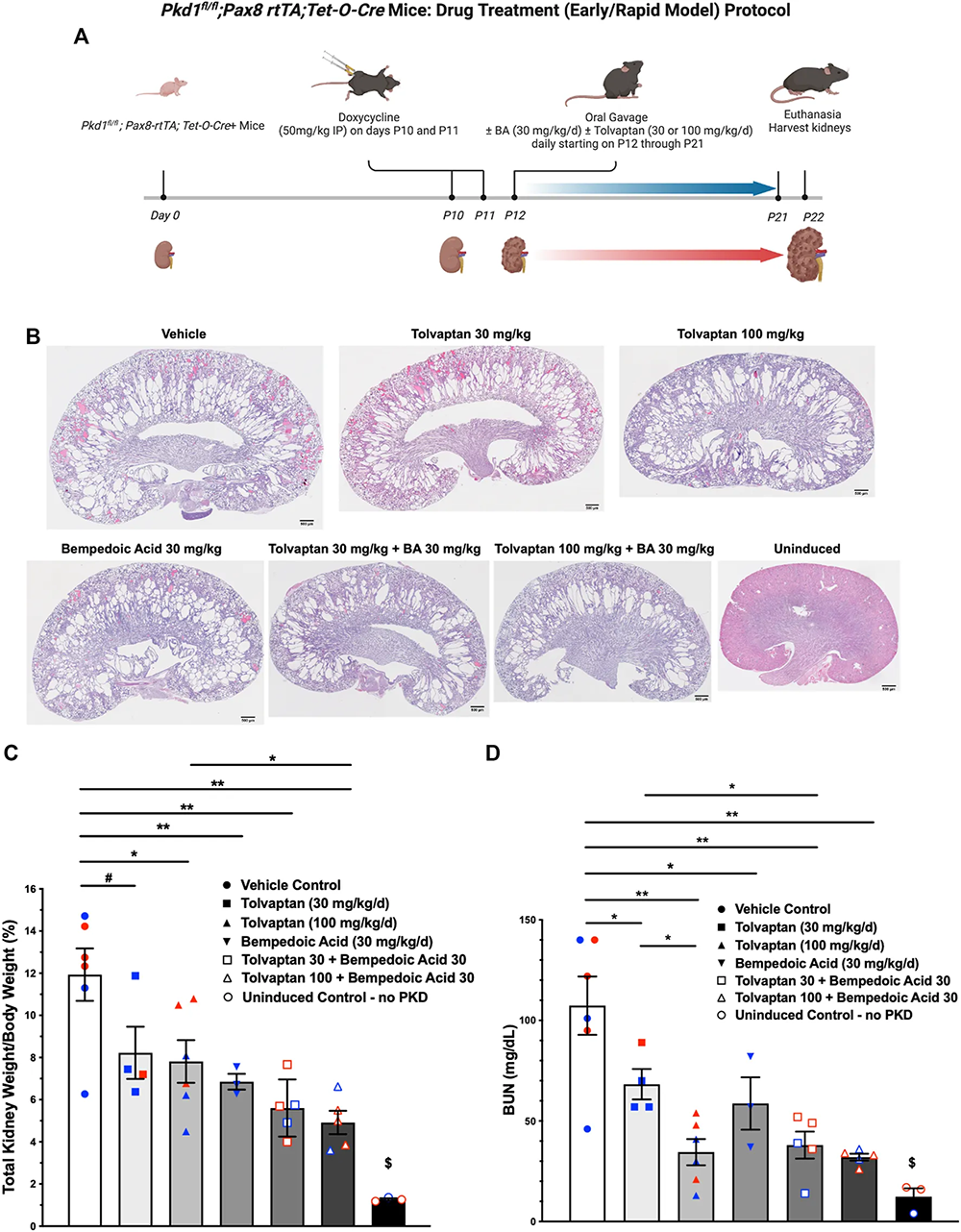
Bempedoic acid (BA) treatment alone and in combination with tolvaptan reduces PKD disease severity in an early/rapid induced Pkd1 gene inactivation ADPKD mouse model. As measures of disease severity in vivo, Pkd1fl/fl; Pax8-rtTA; Tet-O-Cre mice were induced with doxycycline to inactivate Pkd1 and then treated ± BA ± tolvaptan for 10 days prior to euthanasia, as shown schematically (A), and then total kidney weight/body weight ratio (TKW/BW) and blood urea nitrogen (BUN) levels by iStat were evaluated as described in Materials and Methods. (B) Representative H&E-stained sagittal kidney sections under the different treatment conditions are shown. BA (30 mg/kg/d) reduced mean (±SE) TKW/BW (C) and BUN (D) to a similar extent as tolvaptan (30 and 100 mg/kg/d). Addition of BA to tolvaptan caused further reductions in TKW/BW and BUN vs. tolvaptan alone (*p < 0.05, **p < 0.01, and #0.05 < p < 0.10 for the indicated comparisons). $Significantly different from all other treatment conditions. Data obtained from male and female mice were combined for each treatment condition as mice were studied at ages before reaching reproductive capability. Blue and red data points shown in (C) and (D) correspond to male and female mice, respectively.